
- Public beta
- Accessibility technology
- WebMCP exploration
EasyACR
Designing and building an AI agent-assisted accessibility tool assisting in gathering and recording accessibility reporting evidence.
01 — Context
A focused public beta for accessibility evidence
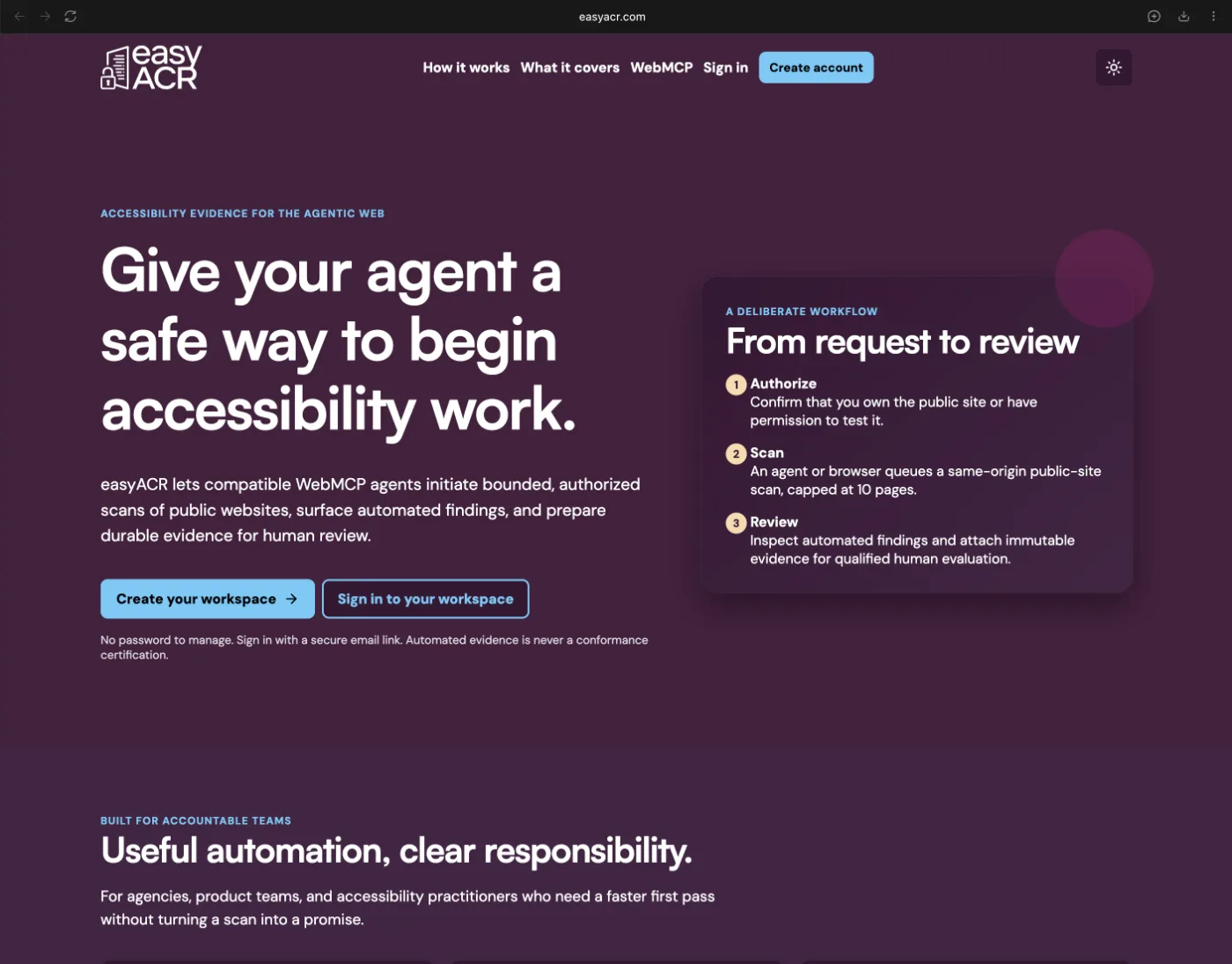
EasyACR is intended for software teams preparing accessibility evidence for procurement and review. The public beta connects bounded website scanning, issue investigation, and a structured draft-evidence workflow. It does not present automated findings as certification or legal advice, but provides an ACR framework to be completed by a human reviewer.
02 — Challenge
Make complex evidence work understandable without overstating the result
Accessibility review combines automated findings with human judgment. The product needed to make that boundary unmistakable while organizing technical results into a workflow a team could understand, revisit, and prepare for further review — and expose useful WebMCP actions without letting an agent exceed the user-authorized workflow.
03 — Approach
Design the product, system, and implementation together
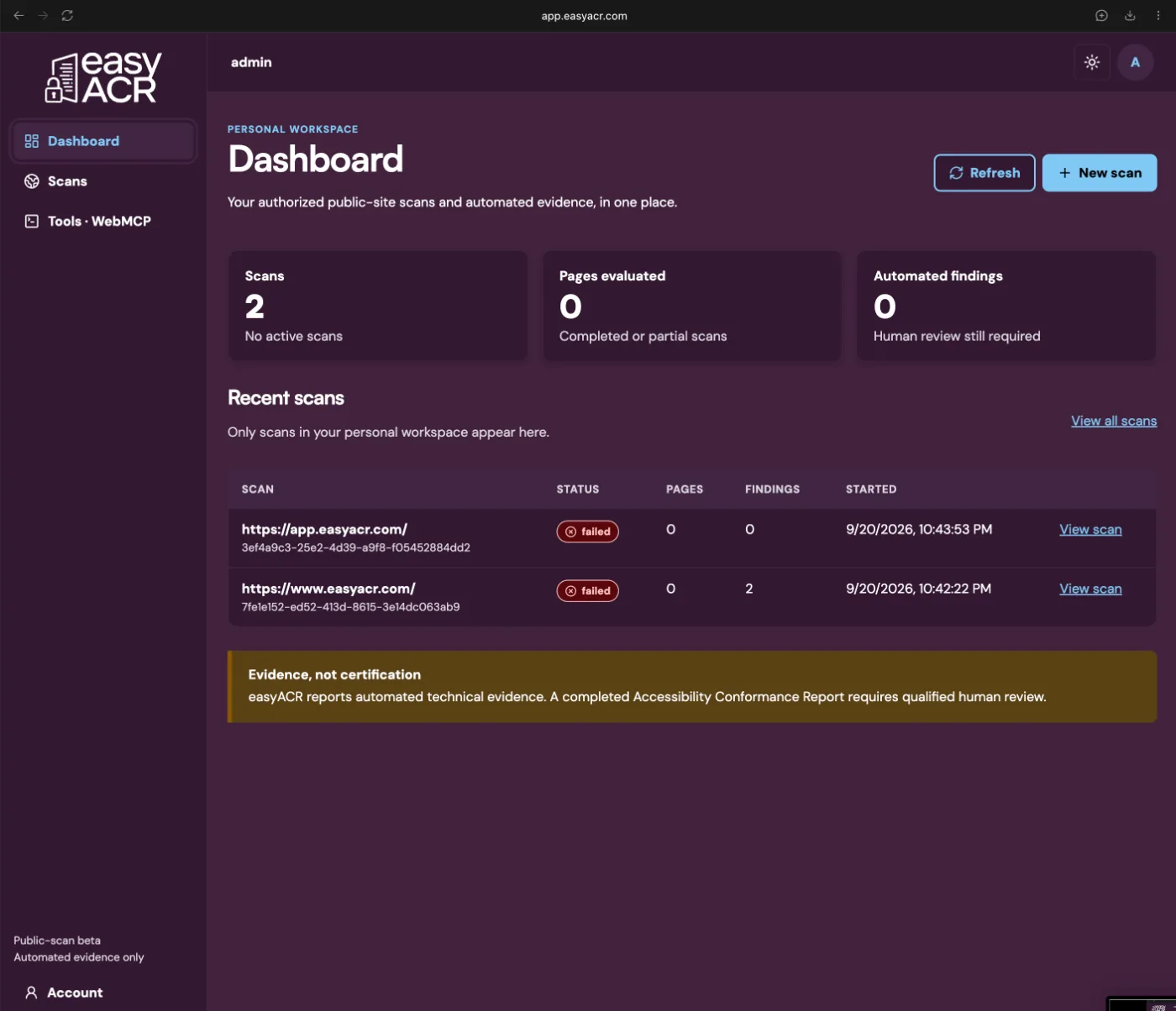
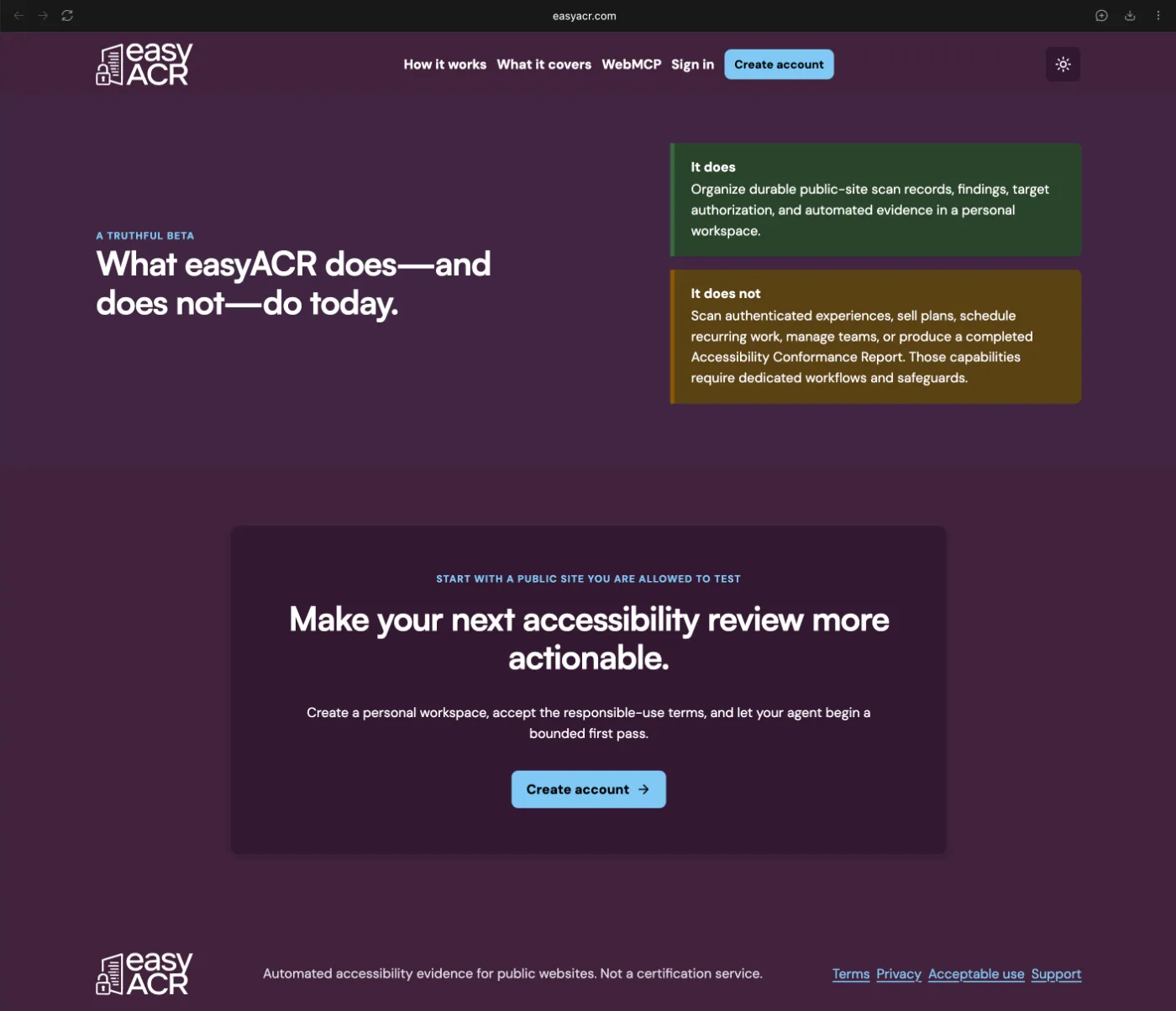
The engagement covered research, product strategy, information architecture, visual identity, a reusable design system, prototypes, accessibility validation, and front-end implementation. The interface separates automated evidence from manual review and applies repeatable components across public, authenticated, report, and draft-evidence views.
Foundations
Product features and safety were defined before the visual identity and responsive component system.
Components
Both the web and MCP versions of scanning, findings, and draft-evidence flows are built from one component set.
Flows
Some checks, including manual WCAG evaluation, must be completed by the user.
04 — Outcome
A live beta and a practical WebMCP learning platform
The public beta launched in early September 2026. It provides a working product experience for public-site scans and draft WCAG evidence while noting explicit review gates. This afforded us the opportunity to learn how WebMCP can support user-initiated actions inside a web product.
Next case study
Sniffle